

I Finally Made a Stainless Steel Fretboard
Sometimes a guitar project starts with a simple idea and quietly evolves into something far more ambitious.
This time, the challenge wasn’t building another neck or installing frets.
The challenge was creating an entire fretboard from solid stainless steel.
After hours of machining, drilling, finishing, and checking measurements, the result is finally here.
“Well, I did it. I got the stainless steel fretboard made. I’ll check back when I get the guitar built…”
The guitar isn’t assembled yet, but the fretboard alone already tells an impressive engineering story.
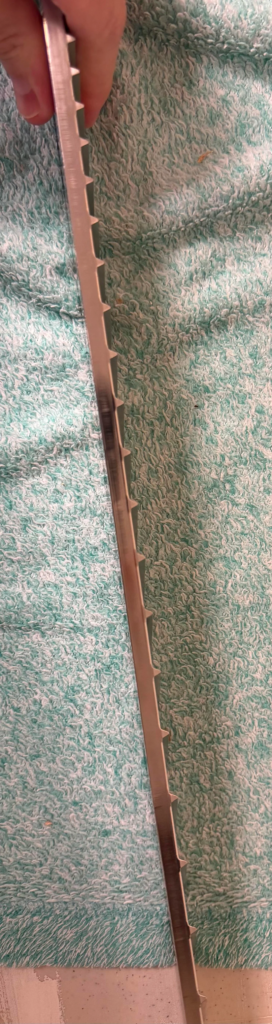
The first image reveals several important construction details.
- Long precision-machined stainless steel bar
- Uniform thickness from top to bottom
- Repeating side notches across the entire length
- Smooth brushed finish
- Straight edges indicating accurate machining
- No visible warping or twisting
- Consistent spacing between the side cuts
The machining appears extremely consistent, suggesting careful CNC programming or very accurate manual machining.
The brushed finish also helps hide fingerprints while giving the metal an attractive industrial appearance
The second image provides an even better understanding of the project.
Visible features include:

Precision Fret Slots
Every fret position appears evenly machined with excellent consistency.
The spacing follows the expected scale progression, becoming closer together toward the higher frets.
Mounting Holes
Multiple countersunk holes run along the center.
These likely serve one of several purposes:
- Mounting the fretboard securely
- Weight reduction
- Mechanical fastening
- Alignment during assembly
Their placement looks symmetrical and carefully planned.

Headstock End
At the top is a centered rectangular cutout.
This could be intended for:
- Neck alignment
- Truss rod access
- Locking feature
- Custom mounting system
Without the complete guitar it’s impossible to confirm, but it clearly serves a structural purpose.
Surface Finish
The machining marks are extremely uniform.
There are:
- No deep scratches
- No visible chatter
- Clean slot edges
- Sharp machining transitions
Overall workmanship appears very clean.
Why Build a Stainless Steel Fretboard?
Most guitars use:
- Rosewood
- Ebony
- Maple
- Richlite
- Composite materials
A full stainless steel fretboard is extremely uncommon.
Possible advantages include:
- Incredible durability
- Nearly impossible to wear out
- Stable in changing humidity
- Excellent dimensional accuracy
- Modern industrial appearance
- Unique playing experience
Potential Challenges
Every custom design comes with trade-offs.
Possible considerations include:
Weight
Stainless steel is significantly heavier than wood.
Depending on the body design, neck dive could become a factor.
Tone
The finished guitar may produce:
- Faster note attack
- Brighter response
- Longer sustain
The final tonal characteristics will depend on the neck, body, pickups, bridge, and hardware.
Machining Difficulty
Stainless steel is much harder to machine than wood.
It requires:
- Sharp tooling
- Slower cutting speeds
- Proper cooling
- Precision measurements
- Patience
One small machining mistake can be difficult to correct.
Build Quality Observations
From these photos, the workmanship appears to show:
✅ Straight machining lines
✅ Consistent fret spacing
✅ Clean countersunk holes
✅ Uniform brushed finish
✅ Accurate edge machining
✅ Professional-looking surface preparation
The final verdict will depend on how it performs once installed and played, but the fabrication itself looks carefully executed.
What Happens Next?
The most exciting part is still ahead.
Once installed, it’ll be interesting to evaluate:
- Playability
- Sustain
- Neck balance
- Comfort
- String feel
- Intonation
- Long-term durability
- Maintenance requirements
A stainless steel fretboard is rare enough that every build adds valuable real-world experience.
Frequently Asked Questions
Is a stainless steel fretboard practical?
It can be, especially for experimental or high-durability builds. Weight and feel are the biggest factors.
Will it sound brighter?
It may influence attack and sustain, but the overall tone depends on the complete guitar design.
Is it harder to manufacture?
Yes. Stainless steel is far more demanding to machine than traditional fretboard woods.
Can it wear out?
Surface wear should be minimal compared to traditional wooden fretboards, making it exceptionally durable.
Final Thoughts
This project isn’t just another custom guitar part. It’s a bold engineering experiment that pushes beyond traditional luthiery. Judging by the machining visible in the photos, the fretboard shows careful planning, precise execution, and impressive attention to detail. The real test will come once it’s paired with a neck, hardware, and strings, where its unique feel, balance, and tonal character can finally be experienced.
- Best Guitar Strings for Beginners in 2026
- Essential Beginner Guitar Chords Chart: Start Playing Today
- Your First Beginner Guitar Lessons: A Simple Guide
- How Often Should You Change Your Guitar Strings: A Guide
- Guitar Amp Settings Explained for New Players
