

Beginner Guitar Finger Flexibility: Is It a Flexibility Problem or Just Beginner Technique?
Learning guitar is exciting, but every beginner eventually reaches a moment where a simple chord suddenly feels impossible. One of the most common examples is the D major chord.
Many new players notice that their fingers don’t seem to bend like everyone else’s. Their third finger points in a different direction, some strings sound muted, and reaching close to the frets feels awkward.
If this sounds familiar, you’re not alone.
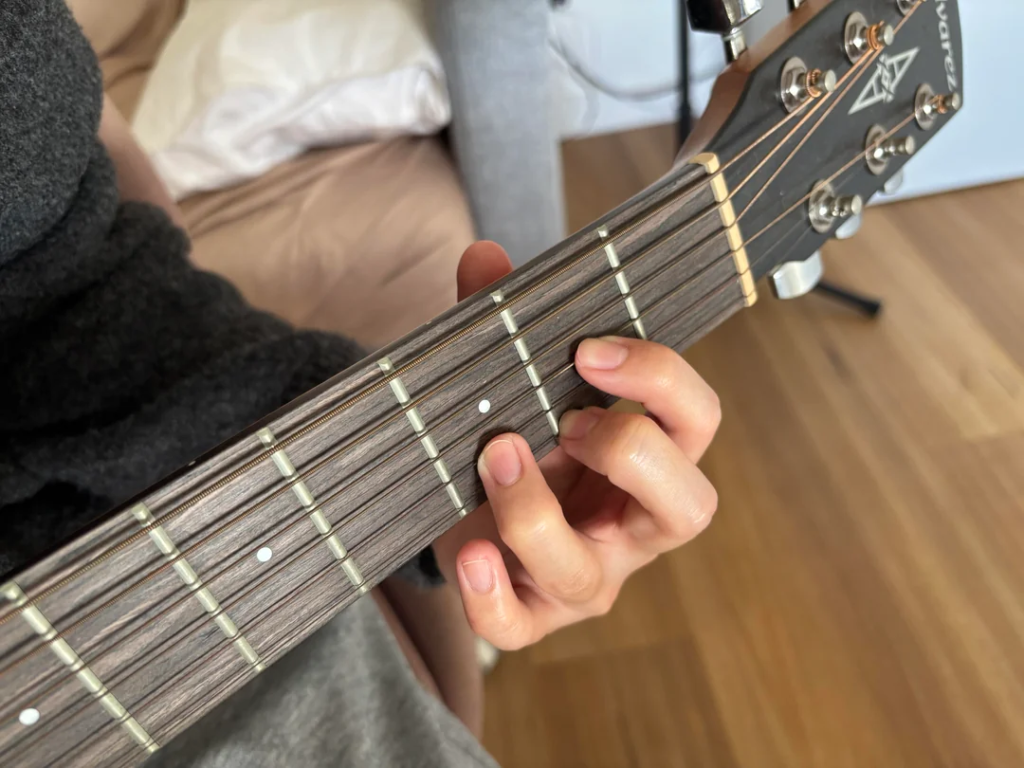
Looking closely at the provided photos, the issue appears to be far more about technique and hand positioning than finger flexibility. The good news? Nearly every beginner experiences this stage, and with a few adjustments, it improves surprisingly quickly.
Table of Contents
- Why the D Chord Feels Difficult
- Image Analysis
- Is Finger Flexibility the Real Problem?
- Common Beginner Mistakes
- Correct Hand Position
- Small Hands: Does Size Matter?
- Finger Independence Exercises
- Daily Practice Routine
- Common Questions
- Final Thoughts
The uploaded images reveal several useful clues.


4
Positive observations
✅ Fingers are curved instead of completely flat.
✅ Thumb appears reasonably positioned behind the neck.
✅ Wrist is not excessively bent.
✅ The player is already attempting fingertip contact.
These are excellent beginner habits.
Areas that need improvement
1. Third finger is collapsing sideways
This is the biggest thing visible.
Instead of approaching the string almost vertically, the ring finger angles inward, making it harder to land close to the fret.
This is completely normal because the ring finger shares tendons with the middle finger.
2. Fingers are slightly too far from the frets
Each finger should sit just behind the metal fret.
Too much distance causes:
- buzzing
- muted notes
- extra finger pressure
- sore fingertips
3. Palm is a little close to the neck
Many beginners squeeze the neck.
Creating a tiny gap between the palm and neck gives the fingers much more freedom.
Imagine you’re holding a tennis ball inside your hand.
4. Ring finger lacks independence
This is probably what the player is noticing.
The ring finger naturally wants to follow the middle finger because of shared muscles and tendons.
This improves with practice rather than stretching.
Is This Actually a Finger Flexibility Problem?
Usually, no.
It’s much more likely to be:
- finger independence
- muscle memory
- wrist angle
- thumb placement
- hand relaxation
True flexibility limitations are actually uncommon in beginners.
Almost every guitarist remembers feeling exactly like this during the first few weeks.
Why the Ring Finger Behaves Differently
The ring finger is the least independent finger on the hand.
The tendons are physically connected.
That’s why:
- it feels weaker
- it moves slower
- it doesn’t point the same direction
- it refuses to stretch
Even experienced guitarists continue training ring finger independence.

Correct D Chord Finger Placement
For a standard D major chord:
E |---2---| Middle Finger
B |---3---| Ring Finger
G |---2---| Index Finger
D |---0---
A |-------
E |-------
Try placing:
- Middle finger first
- Ring finger second
- Index finger last
Many beginners find this easier than placing the index finger first.
Small Hands Are Usually NOT the Problem
One of the biggest myths in guitar is:
“My hands are too small.”
Children as young as six successfully play full-size guitars.
Many professional guitarists also have relatively small hands.
Good technique almost always matters more than hand size.


Tips to Improve Finger Position
Rotate your wrist slightly forward
A small wrist rotation allows the fingertips to approach the strings more vertically.
Lower the thumb slightly
The thumb should roughly stay behind the second finger instead of wrapping around the neck.
This gives better reach.
Keep fingertips rounded
Pretend you’re holding a tiny marble beneath each fingertip.
This naturally creates a curved finger shape.
Move closer to the fret
Instead of pressing in the middle of the fret space, aim just behind the metal fret wire.
You’ll need much less pressure.
Finger Independence Exercises
Exercise 1: Spider Walk
1-2-3-4

Repeat on every string.
Move slowly.
Focus on keeping unused fingers relaxed.
Exercise 2: Finger Lifts
Hold:
Index
Middle
Ring
Pinky
Now lift only one finger at a time.
This strengthens independence.
Exercise 3: Slow Chord Placement
Instead of making the chord instantly:
- place finger one
- check
- place finger two
- check
- place finger three
Repeat dozens of times.
Speed comes naturally later.
Common Beginner Mistakes
- Squeezing the neck too hard
- Pressing far from the fret
- Flattening fingertips
- Looking for perfect finger alignment
- Practicing too fast
- Ignoring relaxed posture
A Simple 10-Minute Daily Routine
| Time | Exercise |
|---|---|
| 2 min | Finger stretching (gentle, no force) |
| 2 min | Spider exercise |
| 3 min | Slow D chord placement |
| 2 min | D chord changes |
| 1 min | Relax hands |
Practicing slowly every day is more effective than one long weekly session.
When Should You Be Concerned?
If you experience:
- sharp pain
- numbness
- fingers locking
- inability to move certain fingers
consider consulting a healthcare professional.
Normal beginner discomfort and fingertip soreness are expected, but persistent pain is not.
Frequently Asked Questions
How long does it take to play a clean D chord?
Most beginners achieve a consistently clean D chord within 2 to 6 weeks of regular practice, though progress varies by individual.
Why does my ring finger point sideways?
The ring finger naturally shares tendons with the middle finger, making it less independent. This is normal and improves with practice.
Are my hands too small for guitar?
In most cases, no. Proper technique and consistent practice matter much more than hand size.
Should I stretch my fingers?
Gentle warm-up stretches are fine, but avoid forcing flexibility. Focus on controlled finger exercises instead.
Should I press harder?
No. Instead, place your fingertips closer to the fret wire. Better positioning usually solves buzzing without extra force.
Expert Verdict
Based on the images and description, this appears to be a normal beginner stage, not a limitation caused by finger flexibility or small hands. The ring finger’s unusual angle is common due to natural tendon connections. With consistent practice, improved wrist and thumb positioning, and finger independence exercises, your D chord will become cleaner and more comfortable over time.
- How to Start Your First Beginner Guitar Practice Session
- How to Tune a Guitar for Absolute Beginners
- Beginner Guitar Finger Flexibility: Why Your D Chord Feels Impossible
- Learning Your First Beginner Guitar Chords
- I Built a Stainless Steel Fretboard From Scratch. Was It Worth It?
