

Guitar Chord of the Day: Learn 7th Chords the Easy Way
![Simple Guitar 7th Chords Guide]
Learning guitar doesn’t have to feel overwhelming. One of the easiest ways to improve your playing is by adding 7th chords to your chord vocabulary.
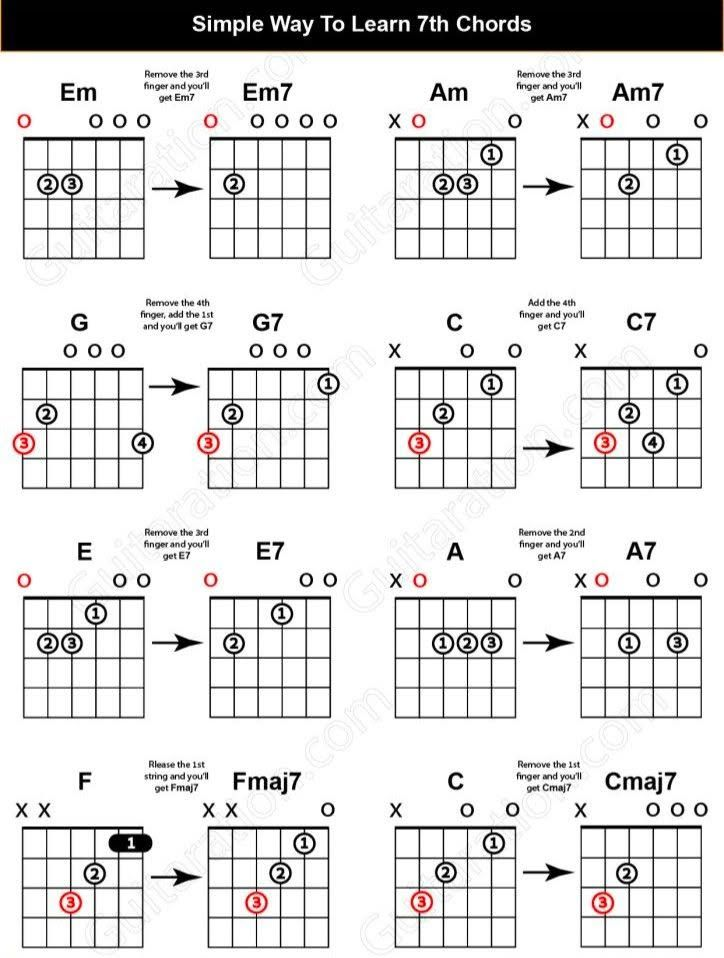
The chart above shows a clever shortcut:
Instead of learning completely new chord shapes, you simply remove or add one finger to a chord you already know.
This makes learning much faster.
Chords Covered
The chart includes:
- Em → Em7
- Am → Am7
- G → G7
- C → C7
- E → E7
- A → A7
- F → Fmaj7
- C → Cmaj7
These chords are commonly used in:
- Blues
- Pop
- Country
- Rock
- Jazz
- Worship music
- Fingerstyle guitar
What Makes a 7th Chord Different?
A major or minor chord has three notes.
A 7th chord adds one extra note called the 7th.
That small change creates a richer sound.
Examples:
- Em sounds dark.
- Em7 sounds softer and more emotional.
Similarly,
- C sounds stable.
- Cmaj7 sounds dreamy and beautiful.
Why Every Beginner Should Learn 7th Chords
Learning 7th chords helps you:
- Improve rhythm playing
- Sound more professional
- Learn songs faster
- Transition between chords more smoothly
- Understand music theory naturally
Many popular songs use these chords.
Easy Trick to Remember
Instead of memorizing eight new shapes, remember these shortcuts.
Em → Em7
Simply lift your third finger.
Am → Am7
Remove your third finger.
E → E7
Lift your third finger.
A → A7
Remove your second finger.
G → G7
Move one finger as shown in the diagram.
C → C7
Add your little finger.
C → Cmaj7
Lift your first finger.
F → Fmaj7
Release the first string.
Small movements.
Huge difference in sound.
Practice Routine (10 Minutes)
Minute 1–2
Play:
Em
Em7
Em
Em7
Minute 3–4
Practice
Am
Am7
Minute 5–6
Practice
C
C7
Cmaj7
Minute 7–8
Practice
E
E7
A
A7
Minute 9–10
Play random chord changes.
The goal is smooth transitions rather than speed.
Real Situation: “I Dropped My Guitar. What Should I Do?”
Many guitar players eventually experience this unfortunate moment.
Imagine this situation:
“I dropped my Jackson guitar while changing strings. A small chunk came off, and the finish cracked. I don’t know how to repair it.”
If this sounds familiar, don’t panic.
Many finish chips are cosmetic and can be repaired.
Step 1: Inspect the Damage
Look closely.
Ask yourself:
- Is only the paint damaged?
- Is the wood cracked?
- Did the neck shift?
- Are the tuners bent?
- Did the bridge move?
- Are electronics still working?
Surface damage is much less serious than structural damage.
Step 2: Check the Neck
Hold the guitar straight.
Look down the neck.
Check whether:
- it’s still straight
- frets are lifting
- neck joint has gaps
If everything looks normal, you’re probably dealing with cosmetic damage only.
Step 3: Tune the Guitar
Tune to pitch.
Then check:
- Does it stay in tune?
- Are strings buzzing?
- Has the action changed?
If the guitar still plays normally, structural damage is unlikely.

Step 4: Never Rush a DIY Repair
Many beginners immediately try:
- Super glue
- Nail polish
- Wood filler
- Paint markers
This often makes professional repair much harder.
If you’re unsure, leave it alone until you’ve assessed the damage.
When Cosmetic Damage Can Be Left Alone
Small chips are common.
Many experienced guitarists proudly keep them because they represent the instrument’s history.
A small finish chip usually won’t affect:
- tone
- sustain
- playability
- tuning stability
When You Should Visit a Luthier
Professional repair is recommended if:
- the wood is cracked
- the neck is damaged
- hardware bent
- bridge shifted
- electronics stopped working
- finish crack continues growing
Can You Repair a Small Finish Chip Yourself?
Yes, if it’s only cosmetic.
Typical repair involves:
- Cleaning the damaged area.
- Matching the finish color.
- Filling with compatible finish material.
- Level sanding.
- Polishing.
However, color matching is often the hardest part.
Prevent Future Drops
Simple habits save expensive repairs.
Always:
- Use a neck support during string changes.
- Work on a soft towel or guitar mat.
- Remove only one string at a time if you’re inexperienced.
- Keep pets and children away while working.
- Never balance the guitar on a chair.
Daily Guitar Maintenance Checklist
- Wipe strings after playing.
- Clean fretboard regularly.
- Store in a case.
- Keep humidity around 45–55%.
- Replace worn strings.
- Check loose strap buttons.
- Inspect screws occasionally.
Beginner Guitar Chord Tips
If you’re just starting:
✔ Practice slowly.
✔ Focus on clean notes.
✔ Avoid squeezing too hard.
✔ Keep your thumb behind the neck.
✔ Practice every day, even if only for 10 minutes.
Consistency beats long, infrequent practice sessions.
Frequently Asked Questions
Do 7th chords make songs sound better?
Yes. They add depth, color, and emotional character without making chords much harder to play.
Will a chipped guitar affect sound?
Usually not. Small finish chips are cosmetic and don’t noticeably change tone or playability.
Can I use super glue on a guitar chip?
Only with care and only for suitable finishes. Using the wrong adhesive or applying it incorrectly can make repairs more difficult.
Should I repair every finish crack?
Not necessarily. If the crack is only in the finish and isn’t spreading, many players choose to leave it as part of the guitar’s character.
How often should beginners practice chords?
Aim for 10 to 20 minutes daily. Regular practice builds muscle memory more effectively than occasional long sessions.
Conclusion
Learning simple 7th chords is one of the fastest ways to make your guitar playing sound more expressive. The chart above shows that many 7th chords require only a tiny finger adjustment, making them ideal for beginners.
If you’ve also experienced the frustration of dropping your guitar, inspect the damage carefully before attempting any repair. Cosmetic chips are common and often harmless, while structural issues should be evaluated by a qualified luthier.
Master one chord at a time, care for your instrument, and keep playing. Small improvements, practiced consistently, add up to confident musicianship.
- Best Guitar Strings for Beginners in 2026
- Essential Beginner Guitar Chords Chart: Start Playing Today
- Your First Beginner Guitar Lessons: A Simple Guide
- How Often Should You Change Your Guitar Strings: A Guide
- Guitar Amp Settings Explained for New Players
