

Dropping your favorite guitar feels like watching a slow-motion disaster. One second you’re changing strings, the next you’re staring at chipped paint, cracked finish, and wondering whether you’ve permanently ruined an instrument that holds years of memories.
If this happened to your Jackson guitar, don’t panic. In most cases, a chipped finish and cracked clear coat are cosmetic damage rather than structural damage. The guitar can still play perfectly, and many professional repairs are almost invisible.
At the same time, while your guitar is waiting for repair, it’s the perfect opportunity to improve your playing by learning guitar chord families, shown in the chart above.
Table of Contents
- What Happens When a Guitar Falls?
- Inspect the Damage Properly
- Cosmetic vs Structural Damage
- How to Repair a Chipped Guitar Finish
- When Should You Visit a Luthier?
- Common Mistakes to Avoid
- Guitar Chord Families Explained
- How Chord Families Improve Your Playing
- Frequently Asked Questions
- Final Thoughts
What Happens When a Guitar Falls?
The most common types of damage include:
- Paint chips
- Cracked clear coat
- Small dents
- Neck misalignment
- Headstock cracks
- Broken tuning machines
- Bridge movement
- Electronics damage (rare)
Your description suggests:
- Small chunk missing
- Cracked finish
- No mention of neck damage
- No broken hardware
That’s actually encouraging.
If the guitar still tunes normally and the neck is straight, chances are the damage is mainly cosmetic.
First Inspection Checklist
Before attempting any repair:
1. Check the Neck
Look from the headstock toward the bridge.
Is it straight?
Any twist?
Any crack near the headstock?
If yes, stop and see a professional.
2. Check the Finish
A finish crack is not the same as a wood crack.
Finish cracks usually:
- are thin
- don’t separate
- don’t move when pressure is applied
Wood cracks:
- open slightly
- continue through the grain
- often feel deeper
3. Test Electronics
Plug into an amplifier.
Check:
- pickups
- selector switch
- volume knobs
- tone knob
- output jack
4. Tune the Guitar
Tune it normally.
Does it hold tuning?
If yes, structural damage is unlikely.
Cosmetic Damage vs Structural Damage
| Cosmetic | Structural |
|---|---|
| Paint chip | Neck crack |
| Clear coat crack | Body split |
| Minor dent | Loose neck joint |
| Finish scratches | Broken headstock |
| Small edge damage | Bridge pulled out |
Most dropped guitars only suffer cosmetic damage.
Can You Repair It Yourself?
Yes, if it’s only finish damage.
Popular repair methods include:
Method 1: Leave It Alone
Many guitarists simply keep the scar.
Battle marks add character.
No risk of making it worse.
Method 2: Drop Fill
Suitable for:
- polyurethane finishes
- polyester finishes
Materials:
- clear CA glue
- razor blade
- polishing compound
- micro mesh pads
This method fills the missing area until it’s level with the surrounding finish.
Method 3: Color Matching
If wood is exposed:
Apply:
- matching paint
- clear coat
- wet sanding
- polishing
This requires patience.
When Should You See a Luthier?
Visit a professional if you notice:
- neck movement
- headstock crack
- fretboard separation
- loose bridge
- buzzing after the fall
- action suddenly changed
- tuning instability
A cosmetic chip rarely needs professional repair unless appearance is important.
Mistakes to Avoid
Don’t:
❌ Sand the damaged area immediately
❌ Use household glue
❌ Apply nail polish
❌ Paint directly over loose finish
❌ Ignore structural cracks
Understanding Guitar Chord Families
The image above shows the most useful guitar chord families.
These are groups of chords that naturally work together because they’re built from the same musical key.

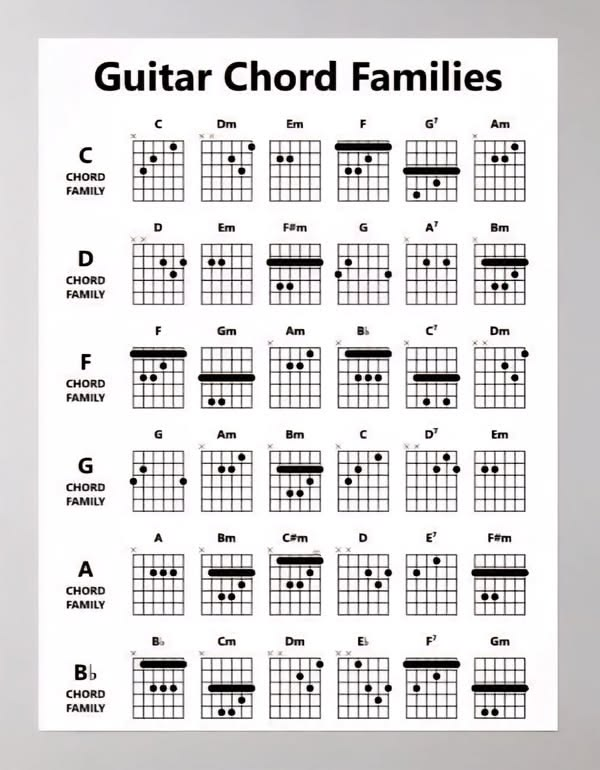
C Chord Family
Includes:
- C
- Dm
- Em
- F
- G
- Am
Perfect for beginners.
Songs in C often use only these chords.
D Chord Family
Includes:
- D
- Em
- F#m
- G
- A
- Bm
Excellent for worship songs, country, and rock.
G Chord Family
Includes:
- G
- Am
- Bm
- C
- D
- Em
Probably the most common key for acoustic guitar.
A Chord Family
Includes:
- A
- Bm
- C#m
- D
- E
- F#m
Popular in pop music.
F Chord Family
Includes:
- F
- Gm
- Am
- Bb
- C
- Dm
Requires learning the F barre chord.
Bb Chord Family
Includes:
- Bb
- Cm
- Dm
- Eb
- F
- Gm
Great for horn sections and jazz.
Why Learn Chord Families?
Instead of memorizing thousands of songs individually, you learn the language behind them.
Benefits include:
- Faster chord changes
- Easier songwriting
- Better improvisation
- Understanding music theory
- Quicker ear training
Practice Routine
Spend 15 to 20 minutes daily.
Day 1
Practice:
C → G → Am → F
Day 2
Practice:
G → D → Em → C
Day 3
Practice:
D → A → Bm → G
Repeat with a metronome.
Increase speed gradually.
Frequently Asked Questions
Will the crack spread?
If it’s only in the finish, usually no.
If it’s in the wood, it should be inspected.
Does a paint chip affect sound?
No.
A finish chip has almost no effect on tone.
Should I repaint the entire guitar?
Only if appearance matters.
Spot repairs are usually enough.
Can I use super glue?
Yes, but only for proper drop-fill repairs.
Avoid using excess glue.
Is professional repair expensive?
Typical cosmetic repairs vary depending on damage, finish type, and color matching. Structural repairs generally cost more because they require stabilization and setup work.
- Best Guitar Strings for Beginners in 2026
- Essential Beginner Guitar Chords Chart: Start Playing Today
- Your First Beginner Guitar Lessons: A Simple Guide
- How Often Should You Change Your Guitar Strings: A Guide
- Guitar Amp Settings Explained for New Players
