

CAGED System Guitar Guide: Unlock the Entire Guitar Fretboard
Learning guitar often feels exciting until players realize they’re trapped playing the same open chords repeatedly. The CAGED System changes that completely.
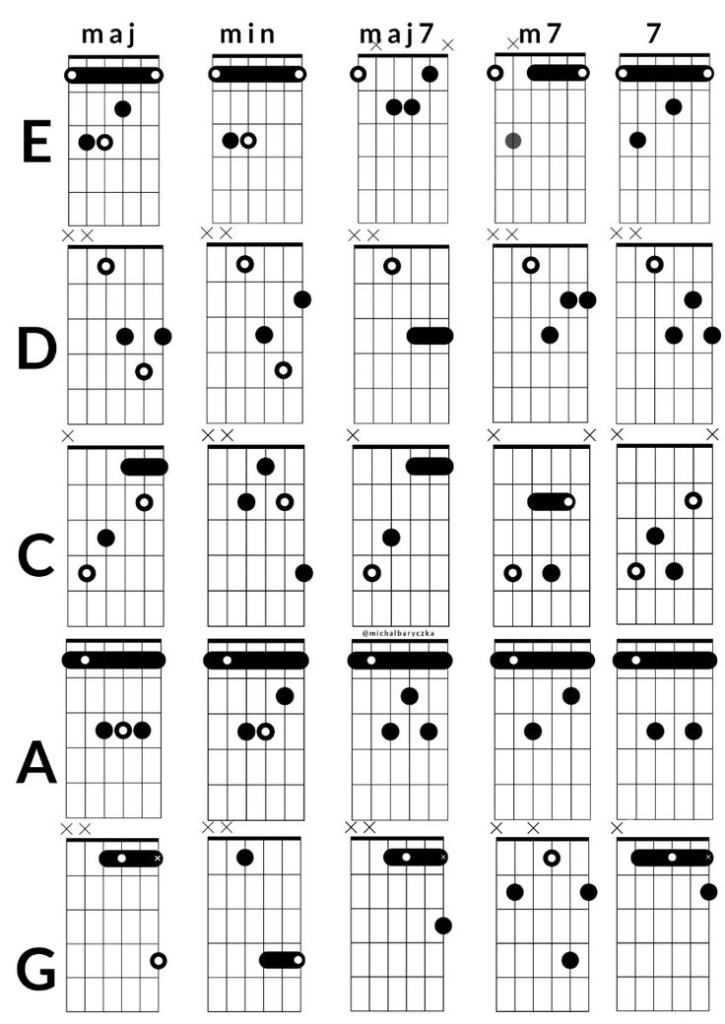
The chart above, inspired by Samjamguitar’s CAGED System series, is an excellent visual reference showing how five simple chord shapes repeat across the fretboard.
Instead of memorizing hundreds of chord positions individually, you only need to understand five basic chord forms.
Those five forms are:
- C Shape
- A Shape
- G Shape
- E Shape
- D Shape
These shapes repeat continuously up the neck, allowing you to play virtually every major chord, minor chord, maj7, m7, and dominant 7 chord anywhere.
What is the CAGED System?
The CAGED System is a method for organizing the guitar fretboard using five familiar open chord shapes.
The name comes from:
- C
- A
- G
- E
- D
Once you understand how these connect together, the guitar neck becomes one continuous map instead of isolated chord positions.
Think of it like connecting puzzle pieces rather than memorizing random locations.
Understanding the Chord Chart
The uploaded chart demonstrates five important chord families.
Major Chords
Major chords create a bright and stable sound.
Examples include:
- C Major
- G Major
- D Major
- E Major
- A Major
Each can be played using all five CAGED forms.
Minor Chords
Minor chords have a darker emotional quality.
Examples:
- Am
- Em
- Dm
- Bm
The chart shows how every major shape has a corresponding minor version.
Major 7 Chords
Major seventh chords produce a smooth jazz-like sound.
Common examples:
- Cmaj7
- Gmaj7
- Emaj7
These are frequently used in:
- Jazz
- Neo Soul
- R&B
- Pop
Minor 7 Chords
Minor seventh chords add warmth and richness.
Examples:
- Am7
- Em7
- Dm7
These appear constantly in:
- Blues
- Jazz
- Soul
- Funk
Dominant 7 Chords
Dominant seventh chords create musical tension that naturally resolves.
Examples include:
- G7
- A7
- E7
These are essential for:
- Blues
- Rock
- Country
- Classic Rock
Why the CAGED System Works So Well
Most beginners memorize chord diagrams.
Advanced players memorize relationships.
The CAGED System teaches relationships.
Instead of learning:
- 200 separate chord shapes
You learn:
- Five movable frameworks.
That dramatically reduces memorization while increasing fretboard understanding.

Visualizing the Fretboard
One of the biggest struggles for guitarists is navigating higher frets.
The CAGED System solves this by showing that every chord repeats.
For example:
Open C Major
↓
A Shape C Major
↓
G Shape C Major
↓
E Shape C Major
↓
D Shape C Major
↓
Back to C Shape one octave higher.
The cycle never ends.
Benefits of Learning CAGED
Faster Chord Recognition
Instead of hunting for shapes, you’ll instantly recognize chord locations.
Better Barre Chords
Most barre chords come directly from:
- E Shape
- A Shape
Understanding CAGED makes barre chords much easier.
Easier Soloing
Lead guitar becomes easier because scales connect directly to chord shapes.
You’ll know exactly where chord tones are located.
Improved Improvisation
Rather than guessing notes, you’ll visualize chord shapes while soloing.
Professional players rely on this constantly.
Better Song Learning
Songs become patterns instead of isolated chords.
You’ll recognize recurring shapes much faster.
Daily Practice Routine
Step 1
Play all five open shapes.
- C
- A
- G
- E
- D
Step 2
Move each shape up the neck using a barre.
Step 3
Name every root note.
Step 4
Switch between adjacent CAGED positions.
Step 5
Practice Major → Minor → Maj7 → m7 → 7 variations.
Common Beginner Mistakes
Memorizing Shapes Without Root Notes
Always know where your root note is.
Ignoring Transitions
The real power comes from connecting shapes.
Only Using Open Chords
Start moving every chord up the neck.
Forgetting Rhythm
Chord knowledge is useless without timing.
Practice with a metronome.
How This Improves Lead Guitar
The CAGED System isn’t only about chords.
Every major scale pattern overlaps these shapes.
Eventually you’ll see:
Chord
↓
Arpeggio
↓
Scale
↓
Pentatonic
All occupying the same area.
That’s exactly how experienced guitarists think.
Best Practice Exercises
Exercise 1
Find every G Major across the neck.
Exercise 2
Play all five C Major shapes.
Exercise 3
Convert every major chord into:
- Minor
- Major 7
- Minor 7
- Dominant 7
Exercise 4
Play a I-IV-V progression using different CAGED positions.
Example:
G → C → D
Without returning to open chords.
Is the CAGED System Good for Beginners?
Absolutely.
It provides structure instead of overwhelming memorization.
Many professional teachers recommend learning CAGED shortly after mastering basic open chords because it creates a strong foundation for rhythm guitar, lead playing, chord extensions, and fretboard visualization.
Frequently Asked Questions
Is CAGED only for acoustic guitar?
No. It works equally well on electric, acoustic, classical, and semi-hollow guitars.
Does CAGED help with soloing?
Yes. It connects chord shapes with scales, arpeggios, and target notes, making improvisation much easier.
Should beginners learn CAGED?
Yes. Once you know basic open chords, CAGED is one of the best systems for understanding the fretboard.
Is CAGED enough to master guitar?
No. It’s a framework, not the entire curriculum. Combine it with ear training, rhythm practice, scales, music theory, and real songs for complete musicianship.
Final Thoughts
The CAGED System transforms the guitar neck from a confusing collection of frets into an organized, repeatable pattern. By learning the five foundational shapes and how they connect, you’ll unlock major, minor, maj7, m7, and dominant 7 chords across the entire fretboard. Pair this knowledge with scales, rhythm practice, and real songs, and you’ll build the confidence to play anywhere on the neck instead of staying locked in the first few frets.
- Best Guitar Strings for Beginners in 2026
- Essential Beginner Guitar Chords Chart: Start Playing Today
- Your First Beginner Guitar Lessons: A Simple Guide
- How Often Should You Change Your Guitar Strings: A Guide
- Guitar Amp Settings Explained for New Players
