

Learning guitar is exciting… until you meet C Minor (Cm).
For many beginners, this chord feels like an impossible finger puzzle. Your fingers don’t seem long enough, the strings buzz, and your hand starts cramping after just a few attempts.
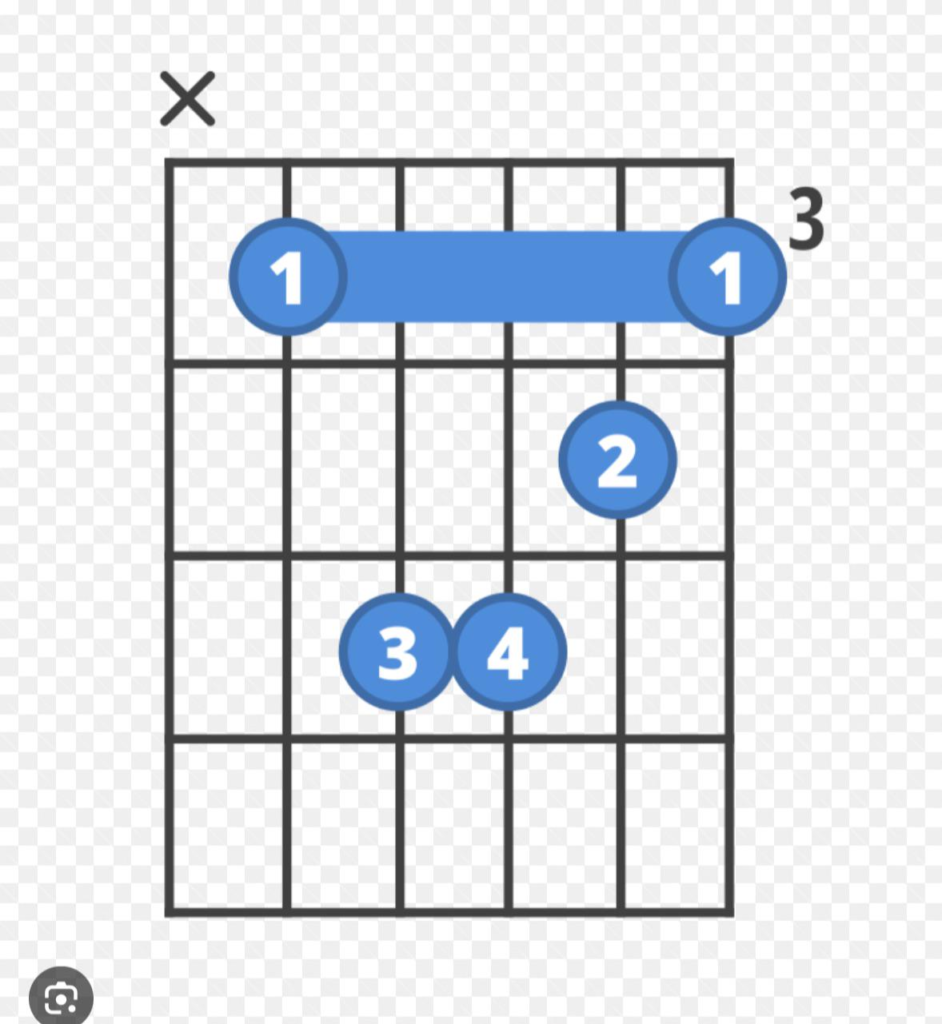
If you’re struggling with the Cm barre chord shown in the diagram above, don’t worry. You’re far from alone. The good news is that with the right finger placement and a few simple techniques, you’ll be playing it cleanly before you know it.
Why Is the C Minor Chord So Difficult?
Unlike open chords, C Minor requires a barre, meaning one finger presses multiple strings at the same time while your other fingers form the chord shape.
This requires:
- Finger strength
- Proper thumb placement
- Good wrist angle
- Consistent pressure across the strings
It’s one of the first major challenges every guitarist encounters.
Understanding the Finger Placement
The chord diagram above shows a standard Cm barre chord rooted on the 3rd fret.
Finger placement:
- Index Finger (1): Barre all strings across the 3rd fret.
- Middle Finger (2): Press the 4th fret of the B string (2nd string).
- Ring Finger (3): Press the 5th fret of the D string (4th string).
- Pinky Finger (4): Press the 5th fret of the G string (3rd string).
Take your time placing one finger at a time instead of trying to form the entire chord instantly.
Step-by-Step Practice Method
Instead of jumping straight into the full chord, build it gradually.
Step 1: Practice the Barre Alone
Only place your index finger across the 3rd fret.
Strum each string individually.
Every string should ring clearly.
If one sounds muted, slightly roll your finger toward its bony edge instead of laying it perfectly flat.
Step 2: Add Your Ring and Pinky
Next, place:
- Ring finger
- Pinky
Leave the middle finger off for now.
Get comfortable holding this shape.

Step 3: Add the Middle Finger Last
The middle finger usually feels the most awkward because it sits between the barre and the other fingers.
Once added, check every string individually.
Tips to Make the Chord Easier
Keep Your Thumb Behind the Neck
Many beginners wrap their thumb over the guitar neck.
Instead:
- Place your thumb roughly behind your middle finger.
- Imagine gently pinching the neck.
This creates much better leverage.
Bring Your Elbow In
Pull your fretting elbow slightly toward your body.
This naturally improves your finger angle and makes barring easier.
Use the Side of Your Index Finger
The side of your index finger is firmer than the flat front.
Rolling your finger slightly makes clean notes much easier.
Don’t Squeeze Too Hard
Most players use far more pressure than necessary.
Instead:
- Press just enough for the notes to ring clearly.
- Let proper positioning do the work.
Common Mistakes
Avoid these beginner errors:
- Flattening your hand against the neck.
- Thumb wrapped over the top.
- Pressing directly on the fret wire.
- Trying to play too fast.
- Ignoring buzzing strings.
Remember:
Slow practice builds clean muscle memory.
Finger Strength Exercises
To build barre chord strength:
Exercise 1
Practice only the index finger barre for:
- 10 seconds
- Rest
- Repeat 5 times
Exercise 2
Switch between:
- Am
- Cm
Slowly move back and forth without worrying about speed.
Exercise 3
Play each string individually after forming the chord.
If one string buzzes:
Adjust only the finger causing the issue.
Does Hand Size Matter?
Not nearly as much as people think.
Players with:
- Small hands
- Large hands
- Short fingers
can all learn barre chords.
Technique matters far more than finger length.
Be Patient
Every guitarist remembers their first barre chord.
It usually feels impossible for a few days or even weeks.
Then suddenly something clicks.
Your hand becomes stronger.
Your fingers naturally find the right position.
And the Cm chord that once seemed impossible becomes just another chord in your repertoire.
Keep practicing for just 10 to 15 minutes a day, and you’ll notice steady improvement.
Final Thoughts
The C Minor barre chord is one of those milestones every guitarist eventually conquers.
Don’t rush it.
Focus on:
- Proper finger placement
- Clean notes
- Relaxed hand position
- Daily practice
Soon enough, this “headache” chord will become second nature, opening the door to countless songs and progressions.
- Best Guitar Strings for Beginners in 2026
- Essential Beginner Guitar Chords Chart: Start Playing Today
- Your First Beginner Guitar Lessons: A Simple Guide
- How Often Should You Change Your Guitar Strings: A Guide
- Guitar Amp Settings Explained for New Players
